Terms used in this article
- API
- An interface that lets two pieces of software talk to each other
- CRM
- Customer relationship management: tracking leads, customers and sales
- ERP
- One integrated system for core operations such as orders, inventory and finance
- MVP
- A first version that does the product's core job
Short answer
Custom software design means building software around your own workflows, user roles, data and business goals, instead of bending your business to fit the limits of an off-the-shelf product. The result can be an operations panel, a CRM, a lightweight ERP, a booking system, a SaaS platform or the automation of a single process. In the Iranian market in 2026, a first version of a single-process tool typically costs 80 to 200 million toman, a multi-role system 200 to 500 million toman, and an integrated company-wide system from 500 million toman upward, with delivery taking 6 weeks to 6 months.
If your staff spend hours every day moving data between Excel, WhatsApp, accounting software and a website panel, or the ready-made tools you bought only cover about 60 percent of what you need, this guide is for you. Below you will see what custom software really is, when it is worth the investment, which types exist, how a project is ordered and how to keep budget and risk under control.
What exactly is custom software design?
Custom (or bespoke) software is designed, coded and maintained for one specific organisation. It differs from packaged software in three ways:
- The business logic is yours: approval steps, pricing rules, task assignment and reports are implemented the way they actually happen in your company.
- Ownership and control: the source code, the data and the future roadmap belong to you, not to a vendor's release schedule or an annual licence.
- Integration: the system is designed from day one to connect with what you already use: accounting, payment gateways, SMS, your website, a Telegram bot or your warehouse.
In practice most custom projects are built as web-based software: they run in the browser and on mobile, need no installation and are available anywhere. That is why at Arcotech this work is delivered under our web application and custom software development service.
What drives the cost of your software?
Describe the core process, user roles and required integrations, and we will review the first-version features, timeline and cost. You do not need a full technical spec to start.
When is custom programming really necessary?
Custom software is not always the right answer. If a packaged product with some configuration covers your needs, building from scratch is wasted money. Custom development starts to make sense when at least three of these signs apply:
- Your core process (the thing that sets you apart from competitors) cannot be modelled properly in any ready-made product.
- Staff jump between two or three applications for a simple task and enter the same data twice.
- Annual licence fees for several tools now exceed the cost of building and maintaining one integrated system.
- Management reports are assembled by hand in Excel every week and nobody fully trusts the numbers.
- You have grown, and the current software struggles with the number of users, branches or records.
- You want to sell the software itself to other companies (SaaS) and need full ownership of the code.
For a deeper comparison see our guide ready-made vs custom software (in Persian). The summary is in the table below.
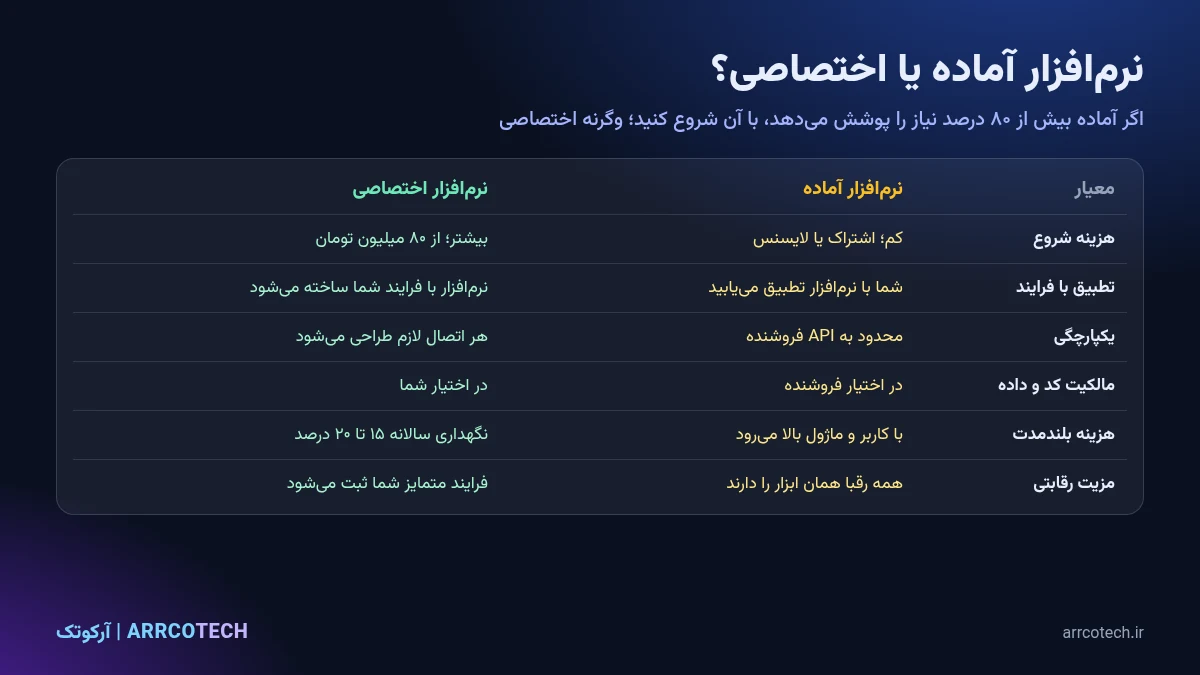
| Criterion | Ready-made software | Custom software |
|---|---|---|
| Start-up cost | Low (subscription or licence) | Higher (from 80 million toman) |
| Time to launch | Days to a few weeks | 6 weeks to 6 months for version one |
| Fit with your process | You adapt to the software | The software is built around your process |
| Integrations | Limited to the vendor's APIs | Any integration you need can be designed |
| Code and data ownership | The vendor | You (per contract) |
| Long-term cost | Grows with users and modules | Maintenance of roughly 15–20% of build cost per year |
| Competitive edge | Competitors use the same tool | Your distinctive process is encoded in software |
What types of bespoke software are there? (with real examples)
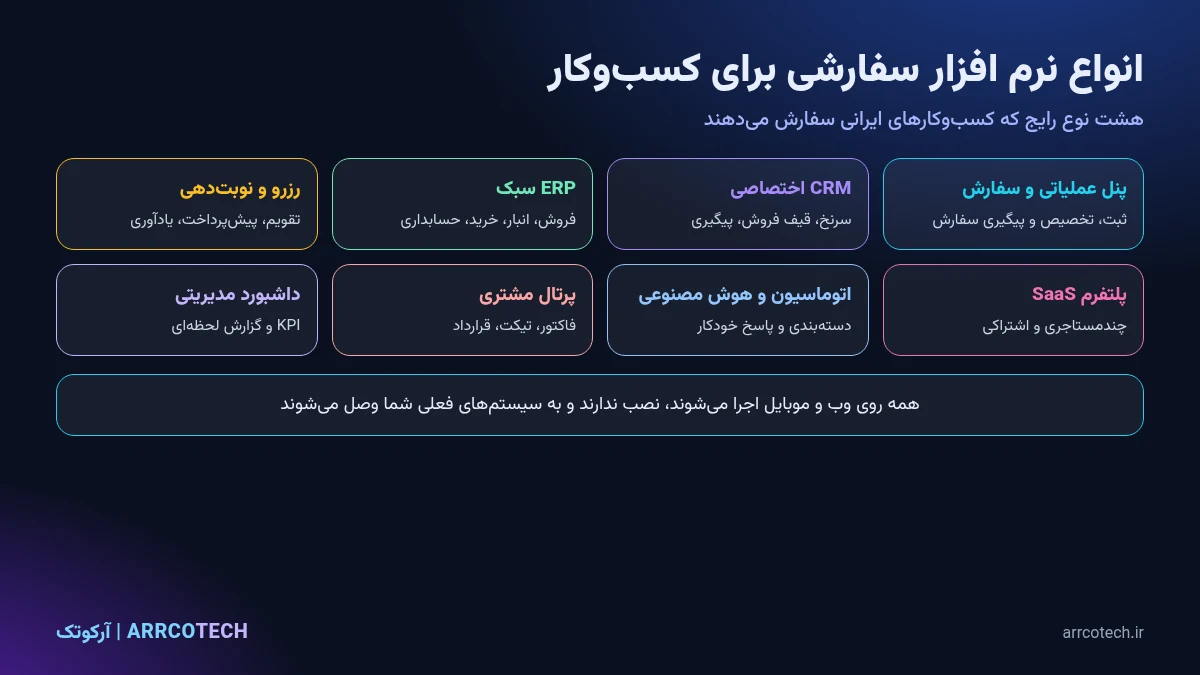
| Type | Practical example | Best for |
|---|---|---|
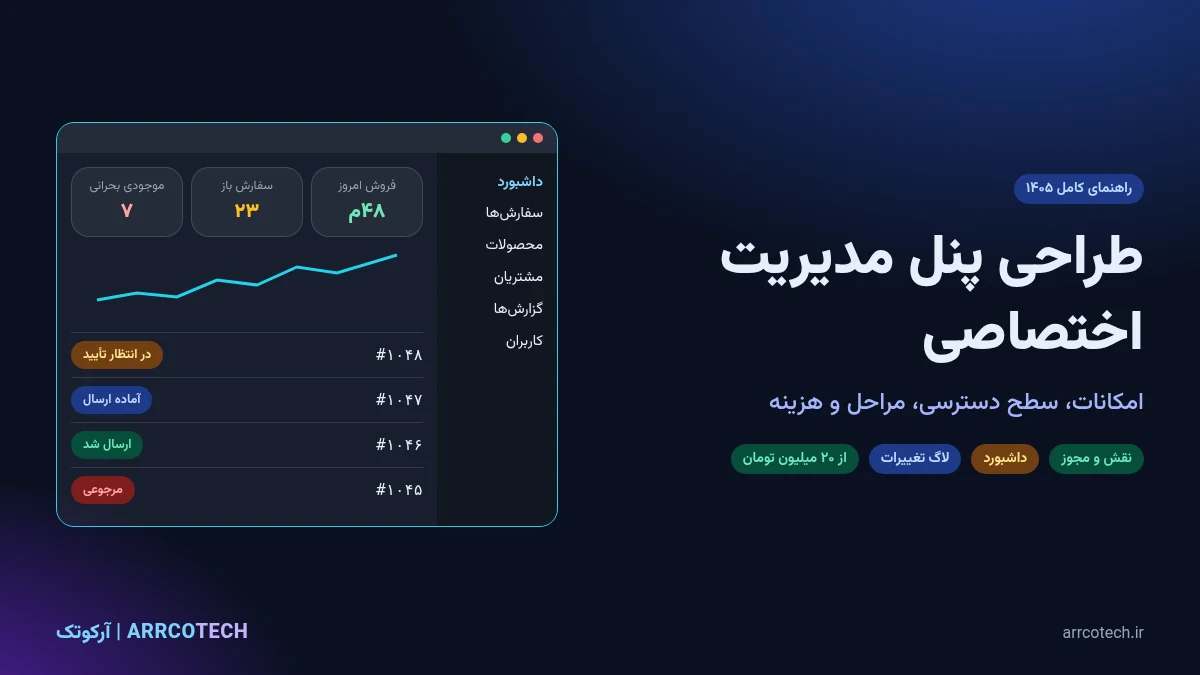
| Operations and order panel | Order entry, assignment to operators, status tracking, automatic SMS | Shops, service companies, distributors |
| Custom CRM | Lead management, sales pipeline, follow-up reminders, sales rep performance | B2B and service sales teams |
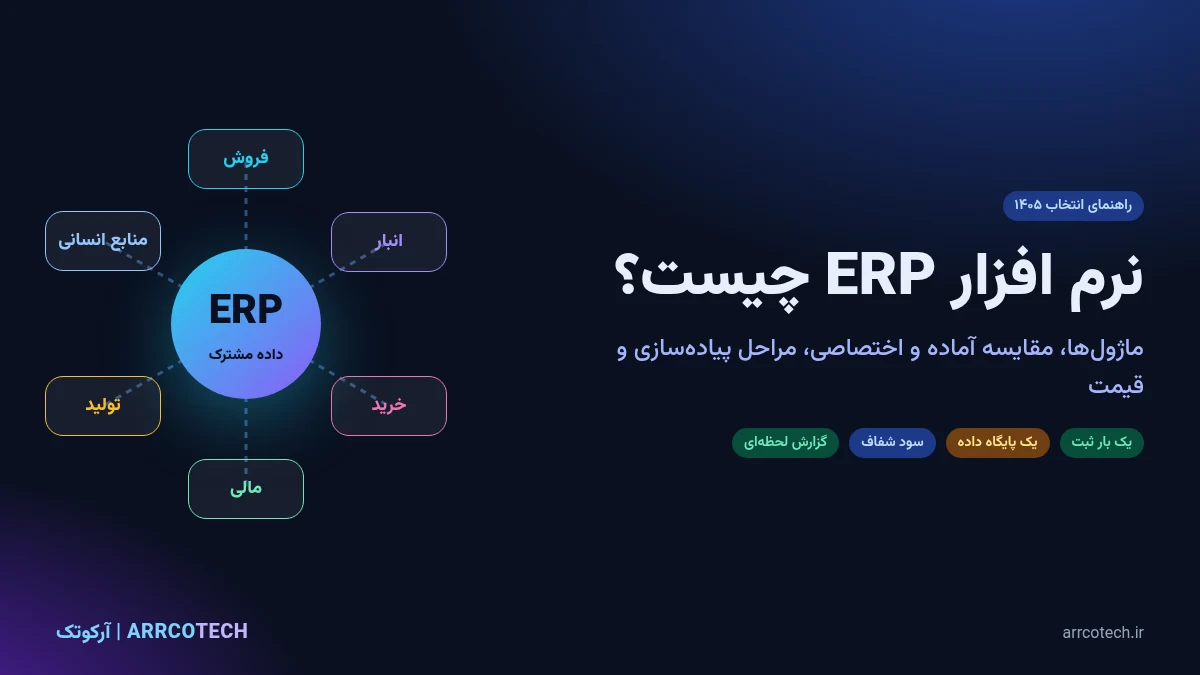
| Lightweight ERP | Sales, inventory, purchasing and accounting link in one system | Manufacturers, restaurant chains, trading firms |
| Booking and scheduling | Resource calendar, deposits, reminders, staff panel | Training centres, salons, service centres |
| SaaS platform | Multi-tenant subscription software sold to other companies | Startups and software companies |
| Automation and AI | Automatic ticket routing, chatbot connected to your data, smart reports | Support and operations teams |
| Customer or partner portal | Customers see orders, invoices, tickets and contracts | Project-based firms and suppliers |
For example, in our café operations and ERP project, the menu, orders, raw-material stock and branch sales reports were unified in one panel so the manager could see every branch without phone calls. If your focus is data management, read custom admin panel design; for integrated systems, see ERP pricing and custom ERP development.
What should a custom software project deliver?
Many clients receive "the program" and only later discover that, without documentation and access, even changing one field depends on the original contractor. A professional project should deliver:
- Requirements and scope document: roles, processes, screens and acceptance criteria for each feature.
- UI/UX design: wireframes and final designs of the main screens, approved before coding.
- Full source code in your own Git repository: with change history, not a zip file at the end.
- Database and API documentation: data structure and integration docs.
- Staging and production environments: so future changes are tested before release.
- Admin panel and permissions: roles, permissions and an audit log of changes.
- Training and user guide: for key users in each department.
- Bug-fix warranty: usually 1 to 3 months after handover.
Custom software design step by step
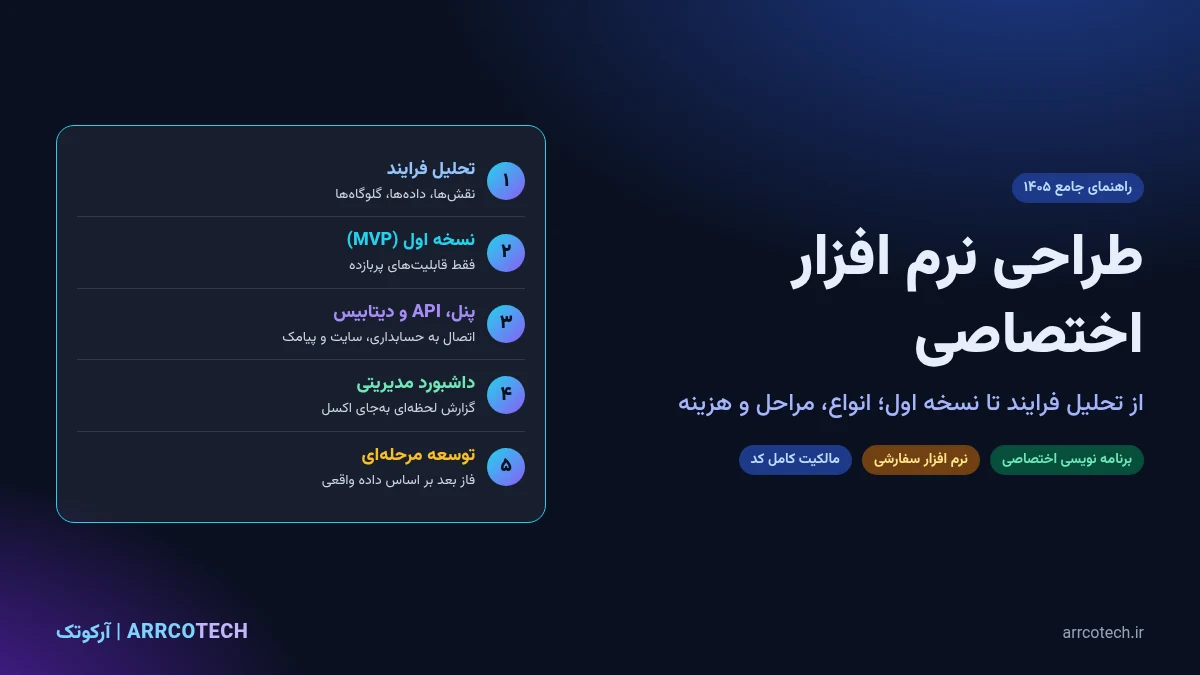
We describe each stage in detail in the stages of custom software design (in Persian). Here is the overview with typical durations:
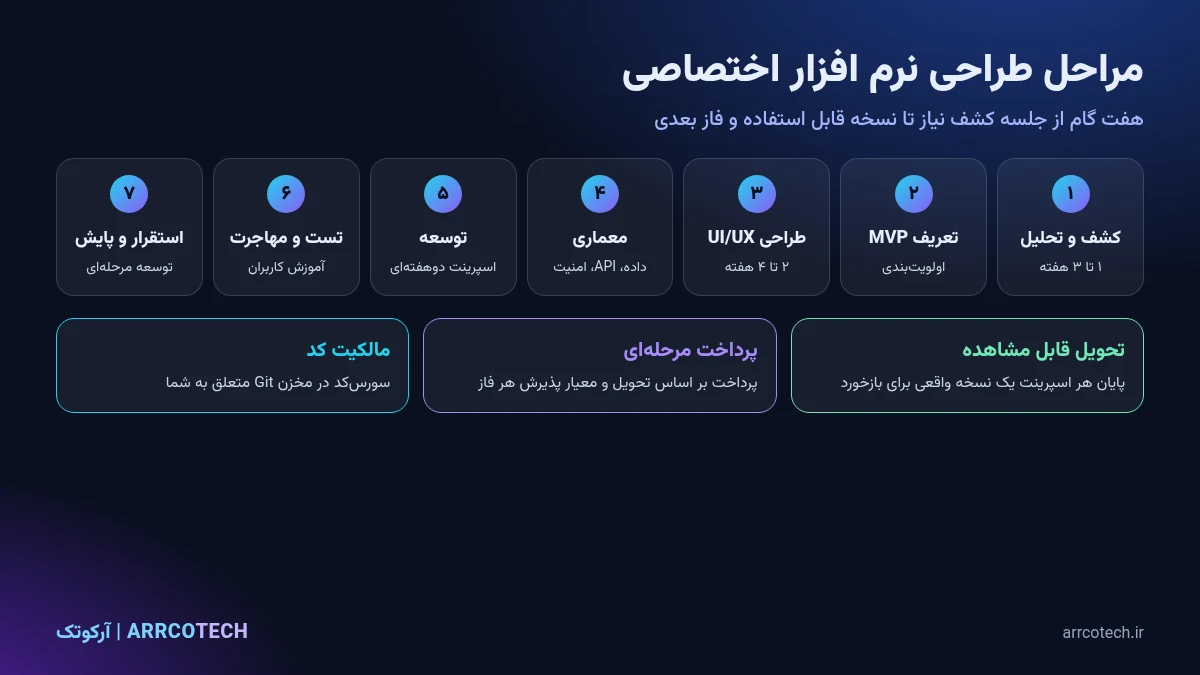
- Discovery and requirements (1–3 weeks): map the current process, find bottlenecks and decide exactly what version one must solve.
- Define version one (MVP): from dozens of ideas, pick the features that save the most time or money; the rest move to phase two. Our MVP development guide (in Persian) makes this decision easier.
- UI/UX design (2–4 weeks): design the journey of every user role and review it with real users.
- Architecture and technology: data model, APIs, security and hosting, for example Next.js for the interface, Node.js or Python on the server and PostgreSQL for data.
- Development in two-week sprints: every sprint ends with a version you can see, so drift is caught early.
- Testing, data migration and training: data from Excel or the old system is migrated and key users are trained.
- Deployment, monitoring and phased growth: after three months of real use, data tells you what phase two should be.
Custom software development cost in 2026
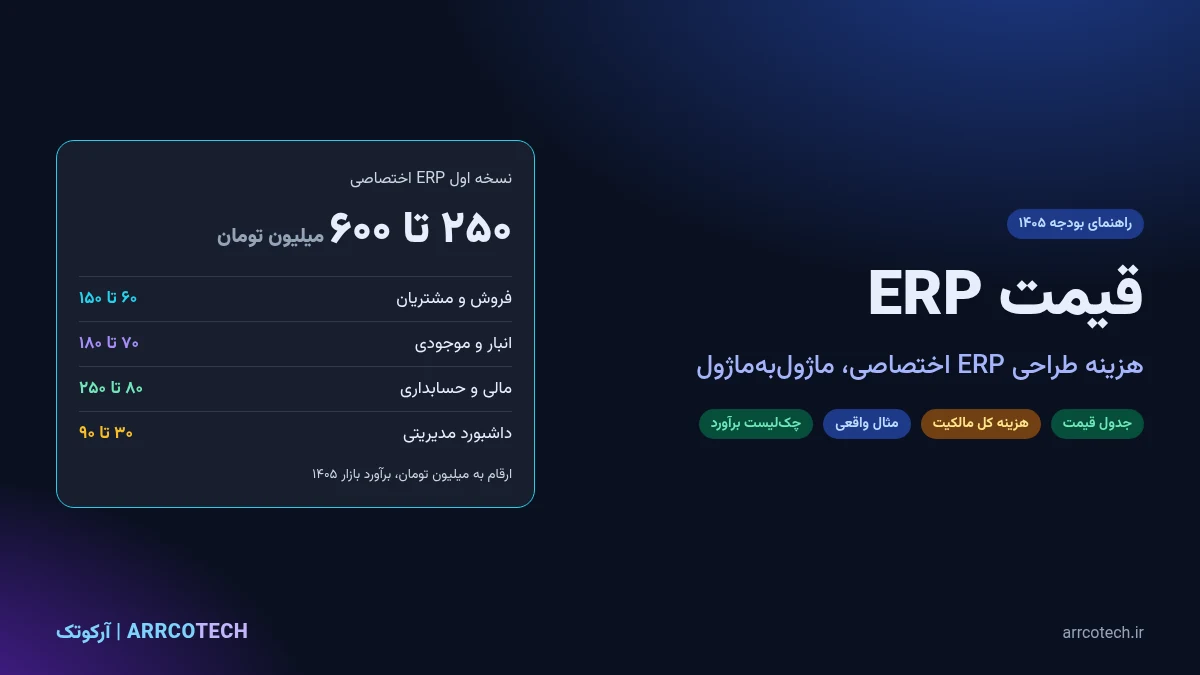
Price depends on the number of roles, processes, integrations, the amount of data to migrate and the security level. The table shows realistic Iranian market estimates for version one. For the full breakdown and estimating formula, read custom software development cost in 2026 (in Persian).
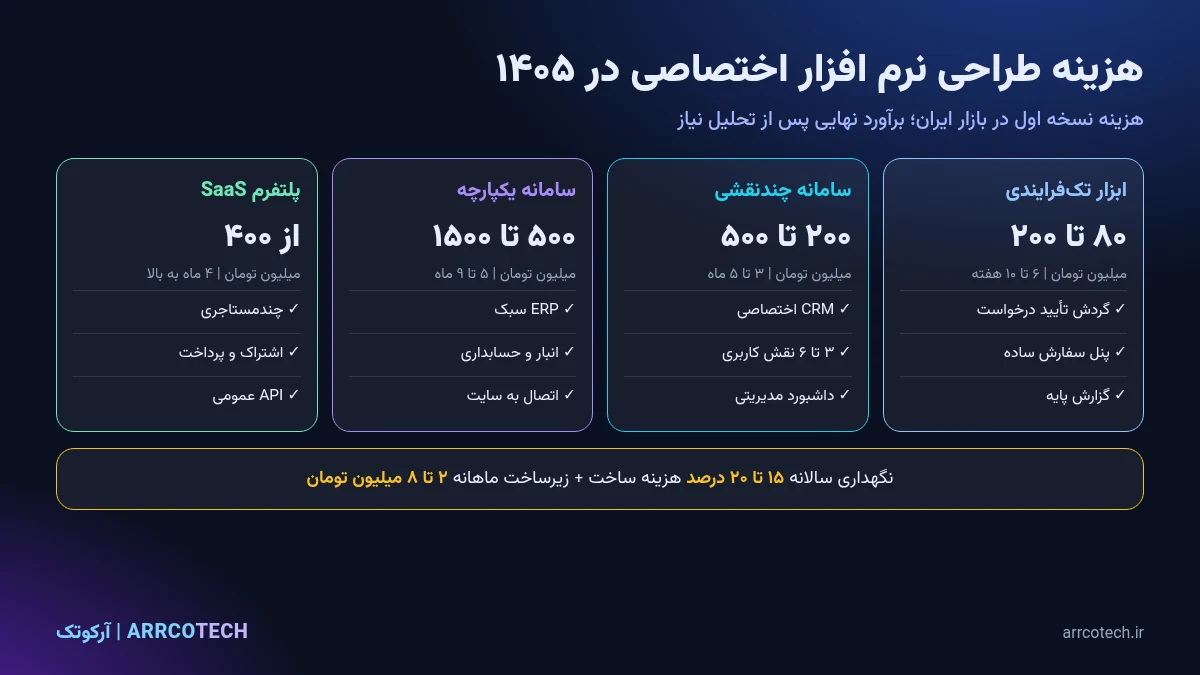
| Project level | Example | Version one cost (toman) | Typical time |
|---|---|---|---|
| Single-process tool | Request approval workflow, simple order panel | 80–200 million | 6–10 weeks |
| Multi-role system | Custom CRM, operations panel with 3–6 roles | 200–500 million | 3–5 months |
| Integrated system | Lightweight ERP linking inventory, accounting and website | 500 million–1.5 billion | 5–9 months |
| SaaS platform | Multi-tenant subscription software | from 400 million (MVP) | 4 months and up |
Three costs that are often forgotten:
- Maintenance and support: roughly 15–20% of the build cost per year for bug fixes, security updates and small changes.
- Infrastructure: cloud server, backups and SMS service; for most small and mid-sized projects 2 to 8 million toman per month.
- Data migration and training: if legacy data is messy, cleaning it can take 5–10% of the budget.
For a quick estimate use the Arcotech price calculator; an accurate quote follows a requirements session.
Real example: a distributor with 12 sales reps
Imagine a food distributor that takes orders on WhatsApp. An operator types them into Excel, a storekeeper checks stock separately and an accountant issues invoices in the accounting software. Each order needs about 25 minutes of manual work and around 1,200 orders arrive per month: roughly 500 staff hours a month, plus frequent stock errors.
Version one of their custom software included:
- A web app for sales reps to place orders at the customer's site
- Real-time stock checks and reservation when an order is placed
- Automatic forwarding of approved orders to the warehouse and a proforma invoice
- A link to the existing accounting software through a standard export
- A manager dashboard with daily sales per rep, receivables and best-selling products
This phase cost about 320 million toman and took four months. Processing time per order dropped from 25 to about 6 minutes, saving around 380 hours a month, more than the salaries of two full-time staff. Payback was estimated at under one year, before counting fewer stock errors.
Checklist before ordering custom software
Prepare these before your first meeting with any software team so the estimate is faster and more accurate:
- ✅ One sentence on the core problem: what wastes our time or money today?
- ✅ The list of user roles and the approximate number of users per role
- ✅ One complete workflow from start to finish (for example from order to payment)
- ✅ Systems that must stay and that the new software must connect to
- ✅ Sample forms, spreadsheets and current reports (without confidential data)
- ✅ The five reports management needs every week
- ✅ A budget range and the date you would like to start using it
- ✅ The decision-maker and the key user on your side
7 common mistakes when ordering custom software
- Starting from a list of screens instead of a process: software must solve a problem, not just have pages.
- Wanting every feature in version one: budget and time double and real feedback arrives late.
- Choosing a contractor on lowest price alone: the cheapest bid usually drops analysis, testing and documentation. See our full criteria in how to choose a custom software company (in Persian).
- No clear contract on source-code ownership: the contract must state delivery of code into a repository you own.
- Leaving end users out of design: software that operators did not help shape is usually abandoned.
- Ignoring maintenance cost: unsupported software breaks within a year at the first regulatory or third-party change.
- Postponing security: roles, logs, backups and encryption must be in the architecture from the start.
The right technology for custom software
Technology should be chosen for the project's needs, the future maintenance team and scale, not for fashion. The stack we use for most web-based projects at Arcotech:
| Layer | Suggested technology | Why |
|---|---|---|
| User interface | Next.js and React | Fast, app-like experience, PWA-ready |
| Server and API | Node.js or Python | Large ecosystem, easy integration with services and AI |
| Database | PostgreSQL | Reliability, safe transactions, strong reporting |
| Infrastructure | Local cloud servers + Docker | Stability in Iran, repeatable deployments |
| AI (optional) | Language models + RAG | Chatbots grounded in your data and automated simple decisions |
If part of your process is repetitive and rule-based, an AI automation layer can be added on the same architecture, for example automatic request classification or report summaries for managers.
Why Arcotech for custom software design?
- We start from the problem, not a big contract: a short, transparent analysis phase clarifies scope and budget before any large commitment.
- Phased, visible delivery: you see a usable build every two weeks and pay per delivered phase.
- Full code and data ownership: source code is delivered into your repository with documentation.
- Real project experience: from a café ERP and operations panels to the Arco AI assistant; see more in the Arcotech portfolio.
- Long-term support: a maintenance agreement with defined response times.
Ready to turn your process into software? Send us one workflow and your main problem through the Arcotech contact page, and in a free session we will walk you through version one, timeline and cost range.
Frequently Asked Questions
How much does custom software design cost?
In 2026 a first version of a single-process tool costs about 80 to 200 million toman, a multi-role system such as a custom CRM 200 to 500 million toman, and an integrated company-wide system from 500 million toman upward. Annual maintenance is roughly 15–20% of the build cost.
How long does it take to build custom software?
A single-process tool takes 6 to 10 weeks, a multi-role system 3 to 5 months and an integrated system 5 to 9 months. With a well-defined version one, the core parts are usually in use within the first two to three months.
Is custom software better than ready-made software?
If your process is standard and a packaged product covers more than 80 percent of your needs, ready-made is the more economical choice. If your core process is unique, you need several systems connected, or licence fees keep rising, custom software is more cost-effective in the long run.
Will I receive the source code?
You should. A professional contract explicitly states ownership of the source code, access to the Git repository, the database and documentation. At Arcotech the code is delivered into a repository owned by the client.
How does custom programming differ from no-code tools?
No-code tools are quick for prototypes and simple flows, but they hit limits with complex logic, many users, security and integration with Iranian services. Custom programming has no ceiling on logic or integration and gives you full ownership.
Can custom software be built in phases?
Yes, and that is the approach we recommend. Version one (the MVP) is built and used first, then further phases are added based on real usage data. This lowers both risk and upfront cost.